

Circle Becomes MiCA Compliant: The Beginning of Regulated Stablecoins
Circle's European regulatory milestone showed how stablecoin issuance can move from a crypto native model toward a regulated form of digital money connected to mainstream financial infrastructure.
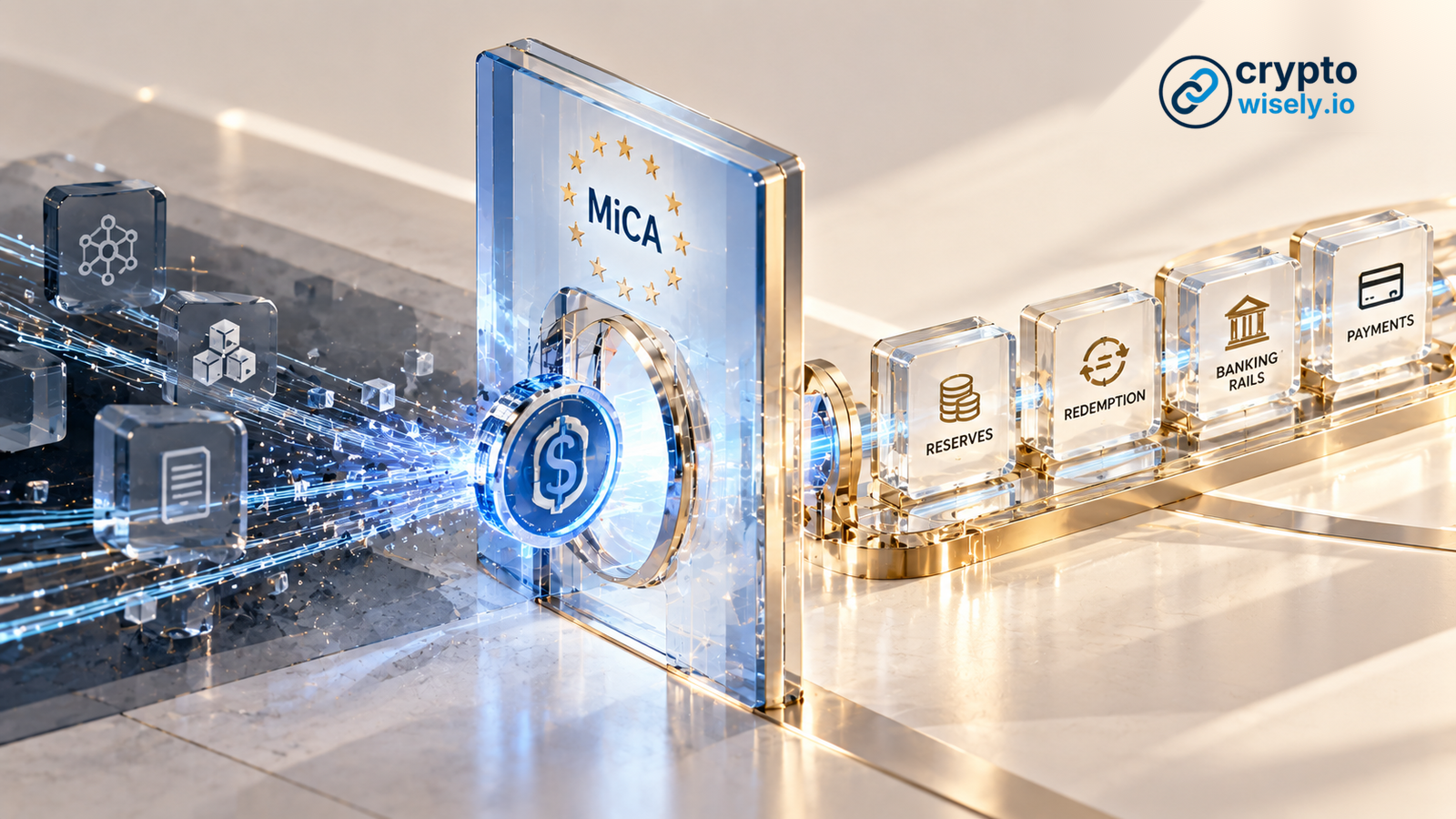
Stablecoins began as crypto native instruments.
They provided traders with a way to move between volatile digital assets without returning to bank money after every transaction. Their first large scale use case was market liquidity.
That role has expanded.
Stablecoins now sit inside discussions about payments, cross border settlement, treasury operations and tokenized financial markets.
As the use case becomes more financial, the regulatory question becomes more demanding.
Who is permitted to issue the instrument? What backs it? How does redemption work? Where are reserves held? What rights does the holder have? Which supervisor is responsible when something fails?
Europe’s Markets in Crypto Assets framework brought those questions into a common rulebook.
Circle’s move into that framework was important because it showed how a major global stablecoin issuer could operate inside a regulated European model rather than outside traditional financial supervision.
Regulation changes the meaning of the instrument
A stablecoin can look simple from the user interface.
One token represents one unit of currency.
The operating model behind that promise is more complicated.
The issuer needs reserve assets. Those reserves need banking relationships and governance. Redemption needs reliable procedures. Customers need clarity around the claim they hold. Supervisors need reporting and evidence that the structure works as described.
Once these requirements become formalized, the stablecoin begins to resemble regulated financial infrastructure rather than a software token with a price target.
That distinction matters.
The market moves from asking whether the token can maintain a peg toward asking whether the institution behind the token can sustain the operating model.
MiCA creates a common European language
Before MiCA, digital asset regulation across Europe developed through a mixture of national regimes, payment rules, electronic money frameworks and crypto specific approaches.
That created uncertainty for companies trying to serve several markets.
MiCA introduced a more harmonized structure.
For stablecoins, the framework distinguishes between different forms of referenced value and places specific obligations around issuance, governance, reserves and redemption.
This gives market participants a clearer language for evaluating the product.
Banks, payment companies, exchanges, custodians and institutional users can assess a stablecoin against a regulatory structure rather than relying only on the issuer’s own disclosures.
That does not eliminate risk.
It makes the responsibilities easier to identify.
Licensing becomes part of the payment architecture
Stablecoin regulation is often described as a legal issue.
In practice, it changes the architecture.
The issuer needs compatible banking relationships. Reserve assets need to sit inside an acceptable framework. Redemption needs to function reliably. Distribution may depend on which intermediaries are permitted to offer the asset. Reporting and governance need to operate continuously.
These requirements shape how the product is built.
A regulated stablecoin is therefore not simply the same token with a licence attached.
The licence changes the surrounding operating stack.
It affects reserve management, customer rights, institutional partnerships and the confidence other regulated firms can place in the instrument.
Redemption is where trust becomes operational
Stablecoins are often judged through price stability.
For institutional users, redemption is equally important.
A token can trade close to its reference value while still creating operational uncertainty if holders do not understand how they can convert it back into bank money, how long the process takes or what happens during market stress.
A regulated framework places more emphasis on that relationship.
The promise of one unit of digital money representing one unit of fiat becomes meaningful only when the holder has a credible route back to the underlying currency.
This is why reserves and redemption should be viewed together.
Reserves support the economic claim.
Redemption proves that the claim can be exercised.
Stablecoins are moving closer to mainstream financial plumbing
The strongest institutional use cases for stablecoins do not depend on users thinking about the asset as crypto.
A company may use a stablecoin because cross border value can move outside traditional banking windows. A treasury team may use it because settlement is faster. A tokenized market may use it because a programmable cash leg simplifies delivery versus payment. A fintech may use it because one instrument can move across several digital platforms.
In each case, the stablecoin behaves more like infrastructure than speculation.
That creates a different standard for success.
The important metrics become reliability, convertibility, liquidity, regulatory compatibility and integration with banking and payment systems.
The more invisible the stablecoin becomes inside the workflow, the more useful it may be.
Regulated stablecoins create new partnership models
A stablecoin issuer does not control the entire financial stack.
Banks can provide reserve accounts, liquidity and redemption connectivity. Payment companies can provide merchant distribution. Exchanges can provide conversion and market access. Custodians can provide institutional safekeeping. Compliance providers can support monitoring and reporting.
Regulation can make these partnerships easier because responsibilities are more clearly defined.
A regulated bank does not need to treat every stablecoin relationship as an experiment if the issuer sits inside a recognized supervisory framework.
This does not remove due diligence.
It gives due diligence a more structured starting point.
Europe also creates a competitive test
Regulation can create market access, but it also raises the operating threshold.
Issuers need legal resources, governance, reserve arrangements and reporting capability. Smaller providers may find the requirements expensive. Global issuers may need to adapt products and operating models to fit local rules.
That creates a competitive effect.
The strongest stablecoins may not be those that move fastest in an unregulated environment.
They may be those that can combine distribution, liquidity and technology with a durable regulatory operating model.
This is likely to matter more as stablecoins become connected to institutional payments and tokenized markets.
The important shift is from permissionless growth to accountable scale
Stablecoins emerged from an environment that valued open access and rapid experimentation.
Regulated finance values something different.
It requires defined responsibility.
The two models do not need to be treated as opposites.
A stablecoin can remain programmable and globally transferable while the issuer operates inside rules around reserves, redemption and governance.
That is the more important lesson from Europe’s regulatory transition.
The future of stablecoins will not be decided only by which token has the largest supply or deepest exchange liquidity.
It will also be decided by which operating models institutions, regulators and users are willing to rely on for real financial activity.
MiCA made that question much more concrete.