

Custody Is Becoming an Operating Model Question
Why institutional digital asset custody is moving beyond key security toward governance, authorization, settlement and operational control.
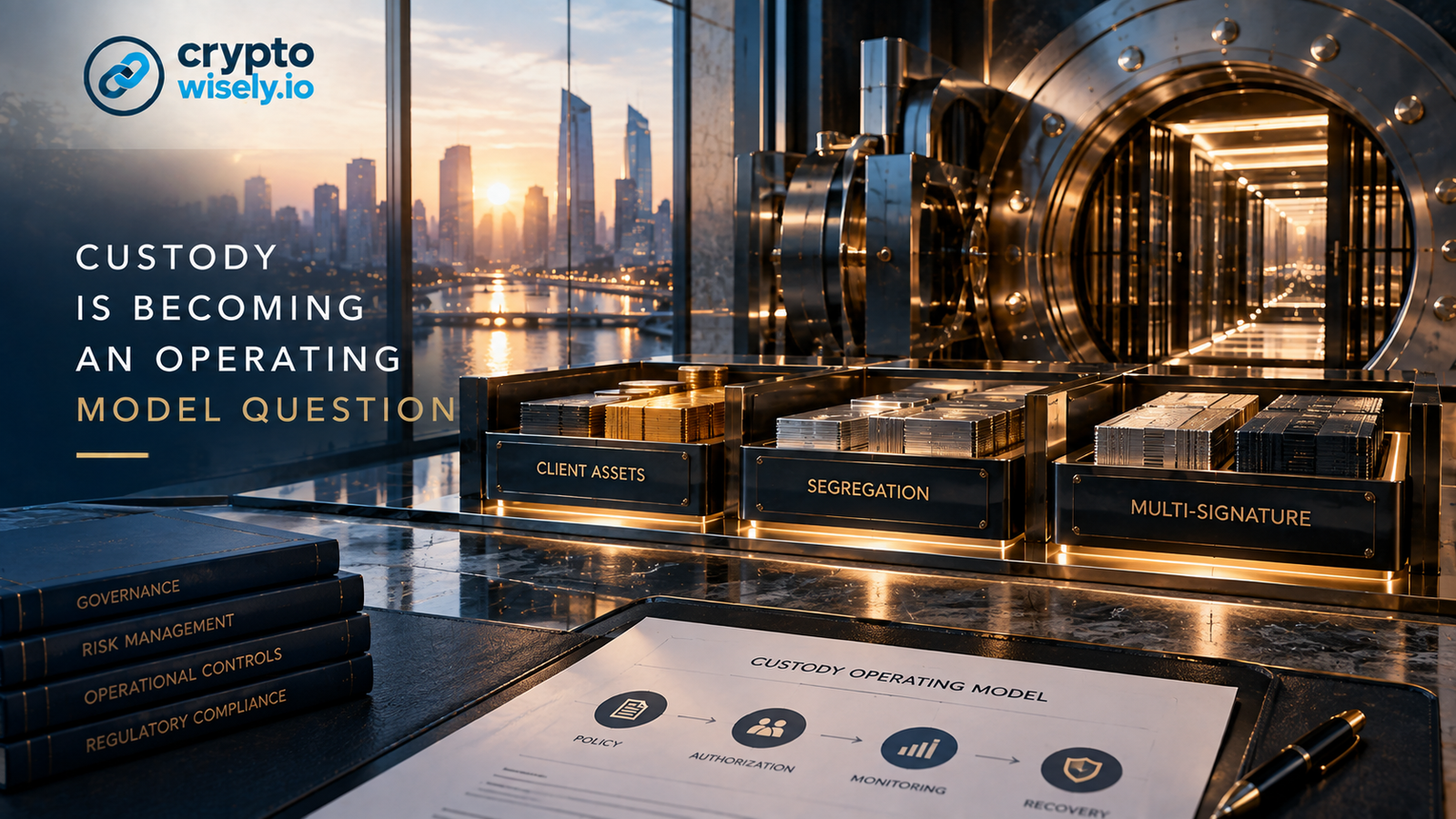
For a long time, digital asset custody was discussed mainly as a security problem. The central questions were familiar: who controls the private keys, how those keys are protected, and what happens if access is lost or compromised.
Those questions still matter. They are simply no longer enough.
As digital assets move deeper into institutional finance, custody is becoming part of a broader operating model. Stablecoins are being considered for payments, treasury activity and settlement. Tokenized funds and securities are being connected to collateral, investment and post trade workflows. Digital assets increasingly interact with systems that were never designed around blockchain based ownership.
In that environment, an asset is not just sitting in a wallet. It may need to move through several controlled processes during the same business day.
Once that happens, custody becomes a question of control.
From safekeeping to operational control
An institution needs more than secure storage. It needs to define who can initiate a transaction, who can approve it, where assets may move, what limits apply, and what happens when something fails.
That introduces a wider set of operating decisions.
Should assets sit in cold storage, operational wallets, or a combination of both? Should the institution rely on a third party custodian, internal wallet infrastructure, or a hybrid model? How are signing authorities separated? Which addresses may receive assets? What transaction limits apply to different teams or systems? Who owns an exception when the normal approval process cannot be followed?
Recovery is another example. A recovery mechanism must restore access when something goes wrong without creating a second security weakness. That requires technical design, but it also requires clear authority, documented escalation paths and accountable decision making.
Network support creates a similar challenge. An institution operating across several blockchain networks is not simply adding technical compatibility. It is accepting different operational conditions, settlement characteristics and risk assumptions.
These are governance questions as much as technology questions.
Stablecoins make the change easier to see
Stablecoins illustrate the shift particularly well.
If an institution buys Bitcoin and holds it as a long term investment, the custody model can remain relatively static. The main objective is secure safekeeping with tightly controlled access.
Now consider an institution using stablecoins for treasury transfers, cross border payments or settlement. The asset may need to move every day. Different employees or systems may initiate transactions. Approval policies may depend on amount, counterparty, destination address or jurisdiction. Activity may continue outside traditional banking hours.
The custody layer is suddenly connected to payment operations, treasury, compliance, risk and reconciliation.
The institution is no longer asking only whether the asset is safe. It is asking whether the asset can be used safely.
That is a different requirement.
A secure wallet is not a complete custody model
A technically secure wallet can still sit inside a weak operating model.
An institution may have excellent key protection but unclear transaction authority. It may have sophisticated signing technology but poorly designed recovery procedures. It may segregate assets correctly but lack a clear process for failed transactions. It may support several networks without defining how different network risks should be assessed and approved.
The wallet is therefore only one component.
A sound institutional custody model also needs authorization policy, segregation of duties, monitoring, reconciliation, exception handling, recovery procedures, network governance and documented accountability.
This becomes especially important when custody connects to trading or settlement. If execution takes place through another venue, responsibility must remain clear as assets move between systems. If a transaction is delayed or rejected, the institution needs to know who can intervene and under what authority.
Operational clarity is part of asset protection.
Exception handling is where the model is tested
Normal conditions can make a custody model look simpler than it really is.
The real test often comes when something breaks.
A signer may be unavailable. A transaction may fail after approval. A destination address may need to be blocked quickly. A wallet may be compromised. A protocol event may change the risk profile of a network. An urgent transfer may need to take place outside the normal operating window.
These situations reveal whether the organization has designed custody as a system of controls or merely as a storage arrangement.
Institutions need predefined escalation paths, authority thresholds and recovery playbooks because improvisation is a poor control mechanism when assets can move instantly.
Custody becomes more important as digital assets become more useful
The more digital assets are integrated into real financial workflows, the more active they become.
Stablecoins can interact with treasury systems and payment processes. Tokenized securities can interact with investment, collateral and settlement workflows. Digital assets can move between custodians, trading venues and internal systems.
Custody sits at the intersection of these activities.
That is why the next phase of institutional custody will probably be defined less by who can build the most secure vault and more by who can provide the control framework required around assets that are active, programmable and connected.
Digital asset custody is still about protecting assets. Increasingly, it is also about governing how those assets can be used.