

Mergers, Acquisitions, and the New Financial Stack
The next phase of digital asset M&A is less about buying users and more about acquiring regulated access, custody, settlement, liquidity and execution capabilities.
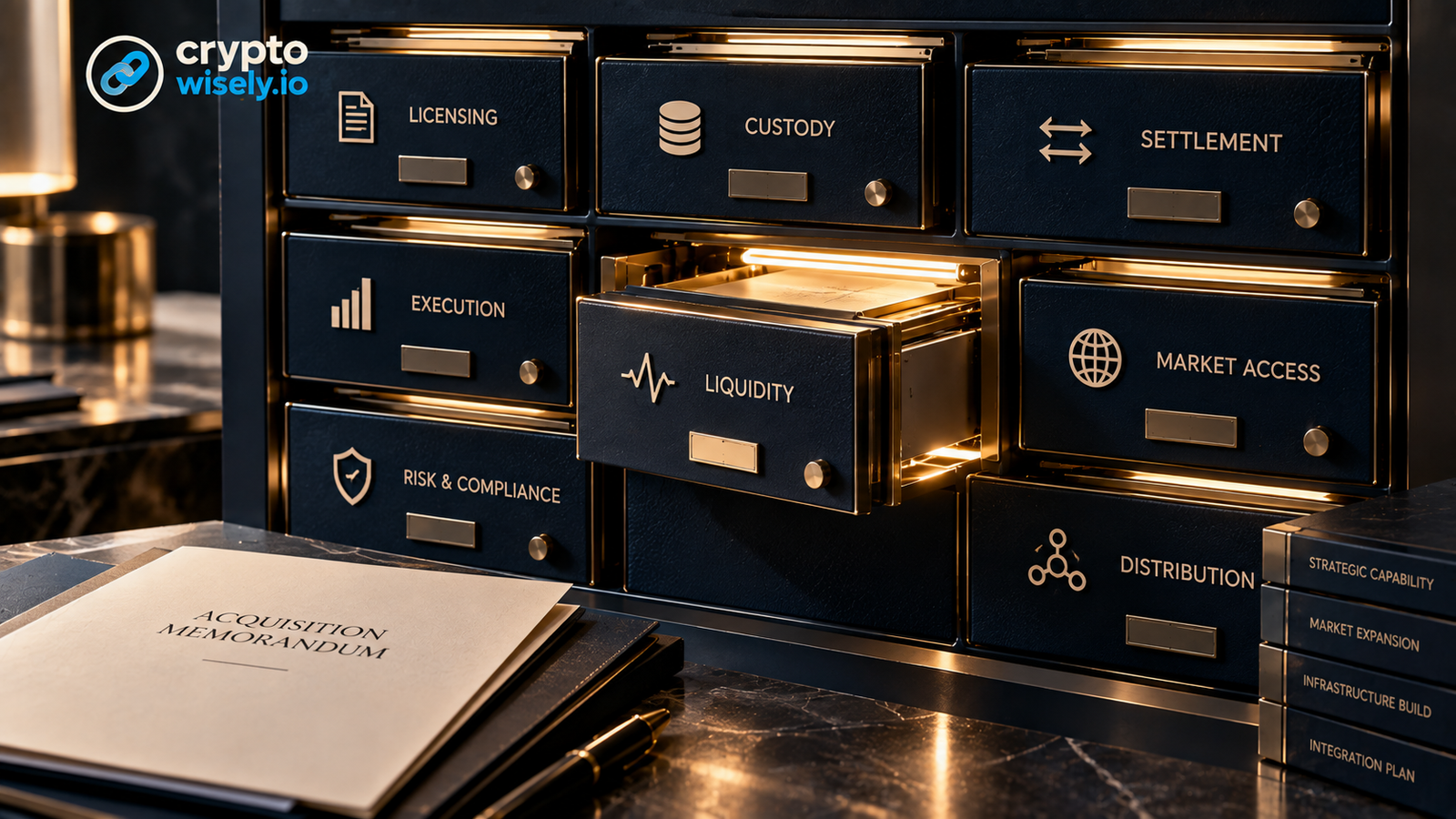
Digital asset mergers and acquisitions are often discussed through valuation, market share or user growth.
Those measures matter, but they miss an important structural shift.
The more strategic transactions in digital assets increasingly concern capabilities that are difficult to build from scratch: regulated access, custody, settlement, liquidity, execution, banking relationships and specialized technology.
The asset being acquired is often not the customer base.
It is a position inside the financial stack.
Banks do not need to become exchanges
Banks have little reason to reproduce the entire operating model of a crypto exchange.
Continuous trading, fragmented liquidity, rapid product listing and twenty four hour market operations require a different technology stack and a different risk culture.
Banks are more likely to acquire or partner for capabilities that fit their existing model.
Custody infrastructure is one example. Regulatory licences are another. Institutional execution, tokenization platforms and settlement technology can also be strategically valuable because they extend the bank’s capabilities without forcing it to rebuild an exchange from the ground up.
The acquisition logic is therefore modular.
Buy the capability that is expensive or slow to build internally. Keep the functions that already belong inside the institution.
Exchanges are acquiring regulated access
The logic also works in the other direction.
Exchanges built technology, liquidity and digital distribution faster than traditional financial institutions. What many lacked was durable regulated access to banking, custody and institutional markets.
For them, acquisitions can provide licences, regulated entities, custody permissions, payment connectivity or relationships that would take years to develop organically.
The value of a transaction may therefore sit in the regulatory perimeter rather than the technology.
This changes how digital asset M&A should be evaluated.
A small regulated business can be strategically important if it creates access to a market, licence or infrastructure layer that the buyer cannot reach efficiently on its own.
Complementary capabilities matter more than similarity
Traditional M&A often looks for scale through similarity.
Digital asset infrastructure can create more value through complementarity.
A bank and a custody provider may fit because each solves a different part of the operating model. An exchange and a regulated broker may fit because one contributes liquidity and technology while the other contributes market access. A tokenization platform and a market infrastructure provider may fit because issuance becomes more valuable when settlement and distribution are already available.
The strategic question is not simply whether two businesses serve the same market.
It is whether their capabilities form a stronger operating stack together.
Integration risk is often organizational
Digital asset acquisitions can fail even when the technology is compatible.
The difficult part is frequently cultural and operational.
Banks are built around controlled change, documented responsibility and regulated risk. Crypto businesses are often built around speed, product iteration and continuous markets. Combining the two without destroying one side’s advantage requires careful design.
If a bank imposes every legacy process on an acquired technology company, it may eliminate the speed it intended to buy. If the acquired company remains too independent, the bank may fail to integrate the controls and governance that justified the transaction.
The operating model after closing therefore matters as much as the valuation before closing.
Joint ventures can be more effective than full acquisition
Not every capability needs to be owned.
Joint ventures and structured partnerships can work well when two institutions need each other’s strengths but do not need full organizational integration.
A bank can provide regulated access, customer relationships and settlement while an exchange provides execution and liquidity. A technology provider can manage tokenization infrastructure while a regulated institution retains legal and operational responsibility.
This can reduce integration risk while still creating a combined service.
The trade off is governance. Shared models need very clear decision rights, service boundaries and accountability.
The stack is becoming modular
The emerging digital asset market looks less like a single vertically integrated institution and more like a set of connected capabilities.
Custody can be separate from execution. Execution can be separate from customer distribution. Settlement can use different forms of digital money. Tokenization can be provided by one firm while servicing remains with another.
This modularity creates more partnership and acquisition possibilities.
It also creates more dependencies.
The institutions that benefit will be those that understand which capabilities are strategic enough to own and which are better accessed through partners.
Architectural relevance is the real acquisition thesis
A useful way to evaluate digital asset M&A is to ask where the target sits in the future financial architecture.
Does it control a licence? Does it provide custody? Does it connect to settlement? Does it provide liquidity or execution? Does it have distribution into an institutional customer base? Does it provide technology that becomes more valuable as tokenized markets grow?
These questions reveal more than user count alone.
The next phase of digital asset consolidation will not be defined simply by who buys the largest exchange or the fastest growing application.
It will be defined by who assembles the strongest financial stack.